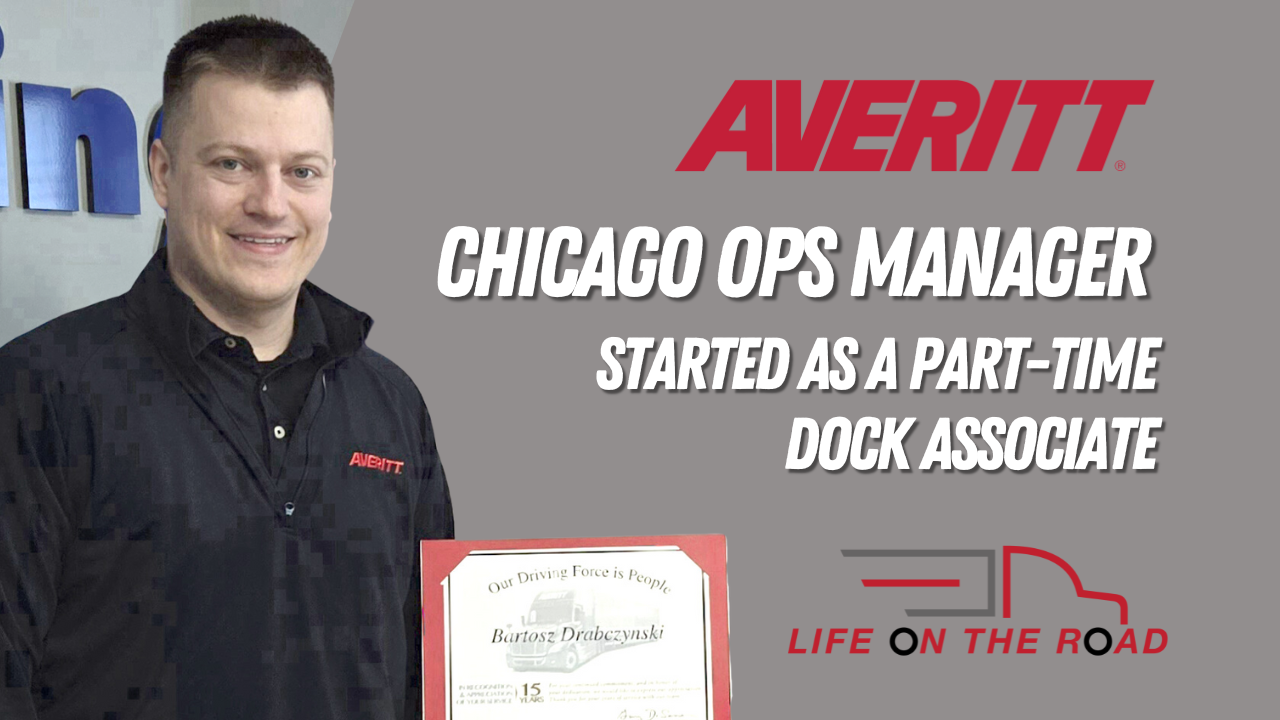







Promoted from Within: Jesus Medina's Journey from Part-Time Dock to Frontline Leader
Jesus Medina has been a valued member of the Averitt team for six years, starting his journey with us as a part-time dock associate. His career...


From great pay and benefits to our late-model equipment to our state-of-the-art facilities, you'll find the best benefits on the road here at Averitt.
The Averitt blog features tips, videos, podcasts, news, and experiences from real team members.
A library of documents and downloads that can help you as you research your future career.
Click below to read real reviews from Averitt drivers and associates.
Want to learn more about an exciting career with us? Stop by an upcoming career fair or hiring event throughout our network!
Our staff of recruiters is available to call or text. Reach out now!
Chat now with our recruiter team to get the answers to your questions.
Answer a few quick questions to determine your best fit at Averitt.
Get the answers to our most frequent questions – or ask your own!
![]()
With so many options, a career in transportation is a smart step for you no matter what stage you are in. At Averitt, we have multiple opportunities to help you fine-tune your skills!
![]() |
![]() |
![]() |
Dock-to-Driver Program |
Leadership Development |
Part-Time Internships |
|
Get paid to work on the dock while learning the skills to earn your CDL. |
3- to 6-month training program designed to prepare trainees for an entry-level leadership opportunity with Averitt. |
Learn about the diverse services we provide while exploring various aspects of the supply chain management cycle. |
16 min read
Averitt Careers
:
9/30/24 12:00 AM
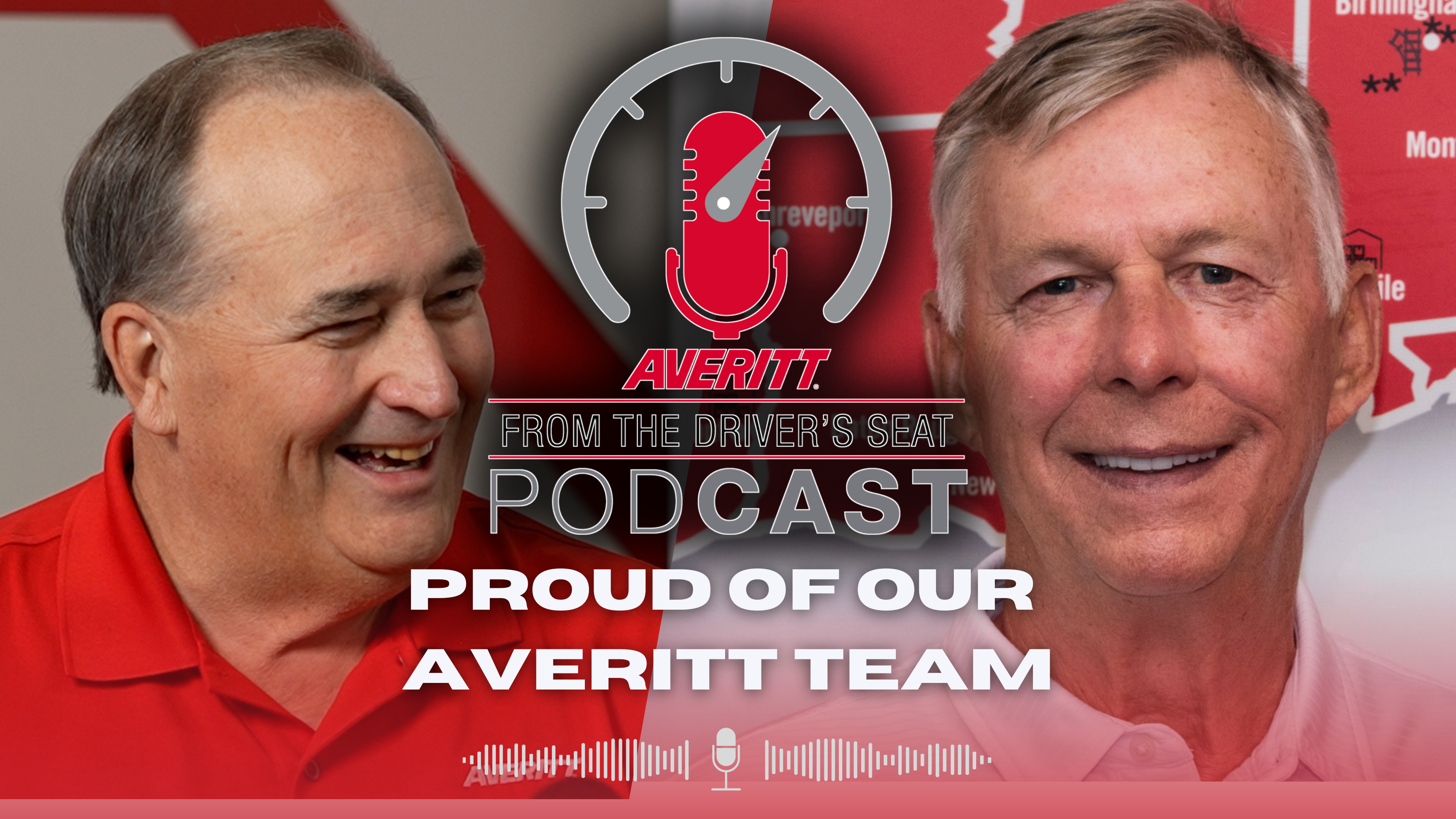
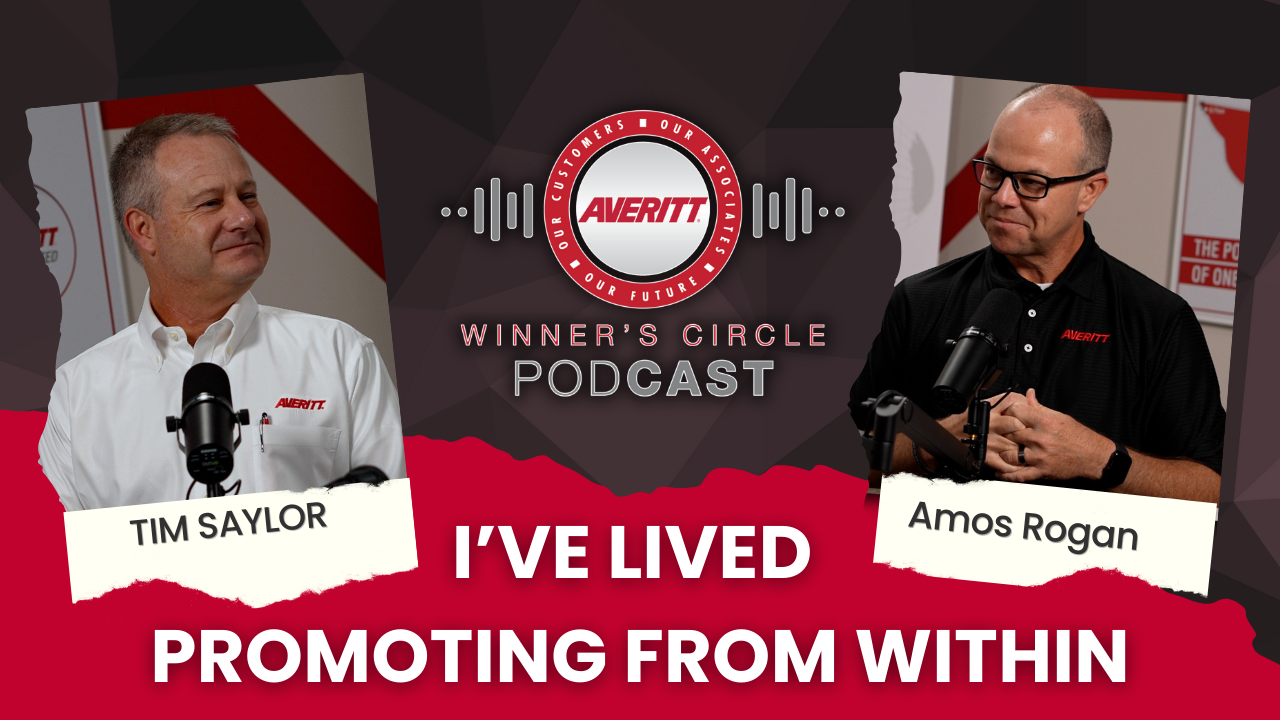
A deeply rooted aspect of Averitt culture is Promoting from Within, and it can be seen from one end of our network to the other. Amos Rogan welcomes Tim Saylor to the Winner's Circle Podcast to talk about Tim's career growth and experience with promoting for within during his career with Averitt.
Welcome to the Winners Circle, the podcast for all Averitt associates no matter where you are or what you do. Don't forget to subscribe on your podcast app of choice so you can be sure not to miss out out on new episodes. And now LTL operations leader and host of the Winner's Circle, James Rogan. Hey. Welcome everybody to the Winner's Circle podcast. Thanks so much for joining us. You know, we're we're so excited about bringing these episodes to you. And one in particularly today, I'm especially excited about because we get to talk a little bit about technology, and everybody gets to take part in technology and what we do. It is such the it's the connecting things. It's the tendons and the ligaments of everything that we do to create that power of one. And I cannot think of anybody else that could talk about this at a better level than our vice president of information services, Tim Saylor. Tim, welcome to the podcast. Pleasure to be here. I think a lot of times, we we take technology for granted. In in a lot of cases, we don't realize how much we rely on it and how much we know that it's there until it's not. I oftentimes think that, you know, when the power goes out at my house and my kids are running around and going, you know, I can't turn a light on it, you know, and we're telling keep the refrigerator shut and all that sort of stuff. You all really pay a lot of attention to our maintenance or contingencies, things of that nature to really make sure that our technology is up and available as much as possible. Talk to us a little bit about how we can you know, you all work with that. Correct. Redundancy is the key word. You know, we we when when I first started here, you know, we would have one line, you know, and that one line goes down. You're down a long time. You know, we'd have one device. That device goes down. A power supply that goes down. So really redundancy is what we've put in place. You know, we've got maps, of of our corporate campus and the redundant lines that we have. It's amazing what we've been able to do. You know, we have redundant equipment. They have redundant power supplies. They have redundant processors. So redundancy is what we're after. High availability. You know, disaster recovery was a was a, a hot topic in the past. Now it's high availability. Everything's sort of hot hot. So we really try to make sure that there's multiple paths to multiple systems. We're always looking to improve those types of things to to really bring more things together for for a more cohesive type of system that kind of talks to each other, provides more transparency and visibility for the users of this technology. That is really what gives us that world class customer service experience that that we're looking for and our customers are asking for. Right. And, you know, we we just got finished, sort of redesigning and rebuilding our our tech support area. You know, it's sort of a command center now. And we're always looking for new new pieces of technology that we can keep an eye on our technology. And they've got they've got TVs, they've got software, they've got different things that that give them a good picture of what's going on within the network. And we also have vendors that that help us out. They they monitor our network. They're always taking a look at at at circuits, equipment. And, really, our customers demand us to be up. They demand our internet to be up. They demand our phone systems to be up. They they want to be able to get a hold of someone when they want to get a hold of someone. And that's sort of the fun part. We're gonna talk about some things a little bit later that's not not so much fun. But that's sort of the fun part, looking at what's new in the world, what can help us, what can help our customers, what can help our associates. And talking about our customers in particularly because, under your leadership, you have the national call center as well. And they, my goodness, are fantastic and and do so many good things for us and not only for our customers, but as a support to our operational associates as well across all of our business units. They can't do their job without the technology side of things in order to give them the information needed and necessary to provide information to our customers, but also support. So, really, our information services team has been able to really tie in a lot of the things coming from the trucks, coming from multiple systems that we use to put it in a single pane of glass for our customer service associates. Right. And and, you know, it was a pleasure to start working with that group. We had worked with them a long time providing technology and so so when Woody retired and and I started working with that group a little closer, it it sort of bonded that relationship between the technology and and the customer service team and our customers. And, you know, it is something that we try to make as easy as possible for our customers to see the data and our customer services associates to see the data. It's not easy because it the data does come from a lot of different directions, but we're we're we're working on a lot of different things even now to make that better. It's pretty good now, but we wanna be great. And to that point, your team does a fantastic job, I think, because I I I work with a lot of them myself, within our P and E team on listening to the users. What, you know, what are some of the pain points within the technology that they're having to do, finding those workarounds, finding those opportunities for improvement? You all have always been very open in communicating with those that are actually putting this technology to use to find out the ways of getting better, not just, oh, hey. This looks pretty good as software as a service coming out of the box. Plug it in. Let's go. You all have taken the time to really manufacture these programs from from a homegrown level. Averitt Drive app or our LTL workflow and our truckloader and dedicated are coming up on it as well. We've made that our own. This this is nothing that that we have really, you know, bought into. We've created it. Right. And that's been fun also. Can't take all the credit for that, definitely, Because we can't dream those things up. We rely on our end users, our operational group, our sales group, our customer service group, finance group. You know, we rely on these groups to help us develop these products. Now on the on the back end, we do a whole lot of development, but that development comes from ideas from our associates. And our associates are brilliant. They really are. They can they can find, new ways to do old things. And if they can sort of think it up, there's a good chance we can put technology to use for their ideas. And and that is, to see those, you know, thoughts and dreams and somebody, you know, ride riding a tow motor across the dock and think of something and and shoot it up the the ladder and making that happen, that's exciting. Yeah. It's a lot of fun. It really is. And in your role, you have to play offense, like what we're finding, you know, new innovative ways of doing things, but you also have played defense as well. And this world is crazy with cybersecurity, cyberattacks, you know, just any malicious way that someone can do something with a computer or a phone or anything for that matter, they're gonna try it. And we're obviously targets, not only because of the size of the company that we are, but the connections that we have with other companies. Cybersecurity is not always the most fun subject to talk about because there's things that we have to do, not we really want to do, but we have to do in order to protect ourselves. We have a great team that really thinks cognitively about what happens in those areas, but I'd like for you to talk about here's the reason why. And, obviously, you know, we had comp one of our competitors last year who who had a very large cyber attack that was successful, and it really opened up our eyes even more than what we were already were. You know, this topic, it it it angers me. It it really does. It's there's there's there's nothing good that comes out of these cyber attacks. You know, it's it's really somebody just stealing from you, attacking you. That that's that's that's really what it is. They are attacking us, and they're trying to attack us every second of every day. When you get your login to our systems, you become part of the solution. Mhmm. And you have to think about it daily. You know, you have to think about it every email that you read. You have think about it every system that you open, every click on the Internet. You have to think about cybersecurity. It's your responsibility. It's our responsibility. Anybody that has those credentials. I look at every training, piece that we send out before we send it out, and I try to make it where it is entertaining, Integrated, where it does remind you to do different things, and I try to make it as short as possible. We don't want people to spend hours on training, but we do have to do the training. We have to keep it in in the forefront of our thoughts when things are happening during the day. You know, going through the cybersecurity trainings that are sent out on a quarterly basis and and even occasionally getting the little attempts from our cybersecurity team to click on something that you shouldn't have. And and, by the way, I have passed all of them so far. Knock on wood. So keep trying, folks. But it's helped, and it's not just helped from the Averitt point of view, but there's a personal side of this as well. It's helped me understand and and and know how to protect my personal, you know, bank accounts, my email addresses, my you know, all this stuff that is interconnected, changing passwords and making them more difficult to figure out instead of password one two three as the universal password for everything that you may have. Those types of things is is helpful and and encompassing in so many different ways. So I totally understand. You know, it's it's one of those things that it's a necessary evil, unfortunately, isn't it? It is. And, you know, not just associates, you know, not just us. We are being required by customers. Right. You know, the the bids that they send in, the contracts that they send in, they speak a lot about securing their data. You know, us being secure, us being that partner that's gonna be available to them when they need it need us. So there are a lot of requirements, that that we're getting outside of our company, and and we do rely on on a lot of partners to help us with that. We can't do it ourselves. We rely on a lot of partners, that that monitor, that do a lot of different things for us. We bounce every cyber decision that we make off of a strong partner. That that's all they do every day, all day long. And that's it's very wise, and I'm glad that we do that and and know that we're not on an island by ourselves when it comes to that. So, obviously, you've had to learn a lot over the years of being on the team and being in the role that you that you're in. You've experienced promoting from within, within your own career. You've you've seen a lot of different movements within the information services team. Why don't you tell us a little bit about how your story started with Averitt and and some of the things that you've seen along the way? I have lived promoting from within. I have I've seen it. I've been part of it and and I've been lucky enough to to be in the middle of of that. I started, actually, I I went home from Tennessee Tech, and I was taking a maternity leave in a school that, the computer lab teacher was having a baby. So I took that position and I get a phone call from a friend in Cookeville that said there was an ad in the paper for something to do with technology, something to do with computers. And I applied to Averitt Express. And a few months later, I was hired for a third shift, prime system operator. And I took the position. It, it was something back in Cookeville that I was familiar with. Wasn't familiar with the company. Learned real quick what the company was about. Worked on third shift, for eight months. And then I was moved to sort of the theme of technology at Averitt, continuous improvement. We were gonna move to a new computer system. So I was placed in in that role. And shortly after I was placed in that role, a new opportunity came up within technology. And I was trained on Banyan Vines, and I was sort of the systems administrator for the the networking system Banyan Vines and that's when we created the networking department. And we had no network. It was a prime mainframe. We had no network and we built the networking department at that time. Spent about eight years running that group and and implementing multiple networks and after after several years on the I series and enjoying the fruits of that, I was placed in a position as a director to be responsible for all technology at that point. And, sort of the rest was history after that. You know, when Woody left, I was privileged enough to work with customer service, so that was sort of added. You know, that was that was one of the easier pieces, because the the the leadership in customer service is, as amazing as it gets. You know, I sort of joke with with some of them. If if anything gets to me, the house is burnt down. That's pretty bad. So it it it just doesn't get to me. They don't they don't they don't need me for those type of decisions. So it has really been a pleasure to to work with customer service. So, you know, that's real quick. There was a lot of things in between that. A lot of a lot of things that happened in between that. But I was I was lucky enough that they had confidence in me. And it wasn't because I was the smartest person in the room by any means. I knew where to find smart people. I think I think that's where, that that's one of my talents. I know I know where to go get the the smart people and we definitely have them. So it's it's been a it's really been a dream. It's been a a very positive experience with with the growth of the company, with the growth of our department, and the growth of our technology and customer service associates. And, obviously, you have to embrace that Averitt culture that we have in order to intertwine what we do from a technology customer service standpoint, into what we do in providing the level of service that we do to our customers that only we can provide. That's what our Averitt culture is able to do. Now you're getting into, being involved with the Scott Wolf Memorial Golf Tournament, which is something that is very near and dear to all of us' hearts as was Scott in being on our executive team for as long as he did. How do you see the golf tournament specifically and and how someone who might be new to the company might get a taste of that Averitt culture and being around that that group at that time? Well, you know, softball tournament does the same thing as the golf tournament. And, one of the one of the things that that you know, I've played in the golf tournament an awful long time. You know, I've never never really helped organize it, and we've got a great team that's that's helping with that. But, you know, what I see is is, you know, you get to play with people that you don't know. Yeah. And, you know, it takes about two shots to get to know somebody because, you know, favorite people are so much alike. Yeah. You know, we like to have fun. We're hardworking. And and we really have one goal in mind, and and that's continuous improvement. And, you know, so it's it's just a lot of fun to to meet new people. It's it's a lot of fun to to be in a a group, that you're competing against the group, you know, next to you. You know? We we also compete real well. You know, the soft softball tournament proves that every year. Oh, yeah. And, you know, you compete hard. You you play hard. You you have a lot of fun, and you come out, you you know, hugging the the people that, you've just competitor competed against. And and and that's sort of how Havert is. You know, we wanna compete. We want to win. We want to to work hard to to meet our goals for our customers. So the the golf tournament brings brings a lot of joy, a lot of fun. You know, and if you just read the the most recent Team Matters, you know, it it's the rewards from this the the the Scott Wolf Memorial Scholarship are vast. You know, the the number of of, scholarships that are being given away is just growing and growing and growing, and that makes you proud. You know? We're helping that cause, and it is in memory of of a wonderful human being. Yes. So that that's what's so important. So the the golf tournament is is something that, you know, more from a long time ago where just, you know, you you picked out a Saturday once a year to get as many people together as you could to now it's really doing what Averitt always does. It's improving all the time, and it's helping others. And, while doing that, you can have a lot of fun. Yeah. Yeah. I always like to say, you know, Scott may not be around anymore to to make a difference, and he made a huge difference in our company. But his memory and his spirit still lives on with the Averitt culture and specifically with this golf tournament and how many kids and just college students as a whole, associates and associate family members, that it's going back to help now. And and I think that, he would be extremely proud of the results that are coming out of that, far more than than he probably ever imagined. So, it's it's a great thing. Tim, I I know that as you've you've said very well in this episode, we're we're looking at continuous improvement. Maybe give us just a little bit of a look ahead down the road about what's coming down the pike when it comes to technology. Some of the exciting things, I'd be remiss not to mention mastery. Some people have, have heard the the word mastery. Some people haven't. Some people that have heard it don't know really what what we're doing with it. You know, essentially, we are looking to replace our transportation management systems. We're looking to replace the LTL four hundred, the TL two thousand, the dedicated two thousand, whatever we wanna call that. We're we're looking to replace, really all of our asset, TMS and some of the non asset with one tool. We've never we've never been on one system. That's been hard for us to manage both in the field and, you know, data wise. So we've we've I'm not saying we've painted ourselves in the corner with our systems, but we're we're getting there. It's it's becoming more and more difficult to do what our customers and associates want us to do with the systems that we have being separated, siloed. Sometimes it's concrete walls between the systems. It's almost impossible to do different things with. So we want to really get to a system that allows us to to be extremely flexible in all divisions. We will probably be leaving the I series in my tenure. We we will have it around quite a while just because of history and and and some of the things that we will have to keep for for quite a while. But it also means that if we're gonna leave that I series, that we're gonna leave a a lot of products that we're currently running that are outside the TMS, a payroll, a finance, a claims, to mention a few. TMT, was on the I series and we're moving off of the I series. So there's gonna be a lot of changes taking place. Some of that's gonna be software as a service. It won't be on premise software. It'll be software in the cloud. But we've got a we've got a bright future. You know, technology is going to help us an awful lot. And even even the technology department is going through some changes. We want we want to be more progressive. In the past, we've always been very conservative as a company and as a department, and we were very reactive. You know, if we we would we would send have improvements made. And then if something broke, we would react really quick, and we would get those things fixed. If people wanted something, they could ask for it. We'd work on it. We'd get it out there to some point in time. And so we were we were, I'd say, good at being reactive, good at moving at a at a decent pace. Well, now we wanna build the department, and we wanna be very proactive, very progressive, aggressive. And we want to work with the departments. We want to work with our operations group to to be quicker to market with products that will help them help the customer. Yeah. We've got to stay ahead, and this comes directly from Barry. This isn't my brainchild necessarily, but we we want to to stay ahead of our competitors, not necessarily on the bleeding edge, but we do want to move to that leading edge. And we've we've been there a few times in the past where we did things that people weren't doing, but we wanna do more of that. We want to give the customers exactly what they need. Yeah. And we want them to tell us what they need. We don't want to tell them what they need. We don't want to tell them this is what you get. We wanna know what the customer wants, and we wanna be able to give that to them. Absolutely. And, you know, I'm glad you're in the chair that you're sitting in, because it's it's always interesting about what's coming about. I always love having these conversations with you about technology and what's coming down the pike. And and, you know, sometimes I come into your office and just go, hey. You know, I've I've found this. We got a problem, and, you know, you're always able to kinda give some direction on that. So we really appreciate everything that you do, but also what you're gonna be doing coming up is is super important. So we, we really appreciate you coming on to the podcast today, Tim. Thank you very much. You know, just as Tim said, our continuous improvement obviously can bring about a lot of good technology. But the thing about that is is it also brings about a lot of change, and that is part of our Everett culture is changing in order to get better. But it's a mindset that we have to do, a mindset in which we have to embrace that change. And I'm reminded of a story of when we put in the tablets in our LTL trucks, I was at our Nashville service center. And that was a driver who had been with us for well over twenty years. And he was watching the videos that we do for training before they get into the truck for the first time with a tablet. And he comes out of the office, and he goes, well, I think today's my last day. And I took it as you're not understanding what we're trying to what we're trying to do as a team. So I said, hold on. Let's go let's go try this out. And the whole time, he was saying, oh, I can't do new technology. I don't like computers, all that sort of stuff. All the while, he had a fairly brand new Bluetooth headset on his head and a big smartphone hanging off of his hip. So it was more about the mindset. So long story short, we go out to the truck. He's still pretty apprehensive about it all. I say, hey. Where are you going? I'm gonna go with you. So I ended up riding with him. Well, at the end of that trip, he knew how to run the tablet. I made a new friend. And what it was is within that within that trip in the city, he changed his mindset of knowing and understanding that we were actually doing something that made his routine, his world, because the world that we live in is pretty crazy. But in his world, we actually did some things to make it better. So that is what I challenge you to do. Think about an open mind to embrace change in order to make ourselves better. Because when you get better, we all get better, and that's how we stay in the winner's circle. So be blessed, be safe, and we'll talk to you next time.
Are you excited to become an Averitt associate and experience the opportunity for growth? We'd love for you to experience our unique and amazing culture! See all open positions now:
Jesus Medina has been a valued member of the Averitt team for six years, starting his journey with us as a part-time dock associate. His career...
In the latest episode of From the Driver Seat, host David Broyles sits down with Ed Smith to spotlight one of Averitt’s fastest-growing...
Promote From Within is a cornerstone of our culture, and we have countless stories that show how we truly support and uplift our associates...
17 min read
John Walton's Averitt career spanned four decades, starting in Memphis and wrapping up at our corporate office. From part-time driver to director of...
If you're looking for a great example of Averitt's culture of promoting from within, it's Vincent Washington. Vincent started his Averitt career as...
"Keep the driver moving." That's the motto of Dustin Dykes, Preventive Maintenance Front Line Leader at our Tifton, GA service center. Dustin, a...