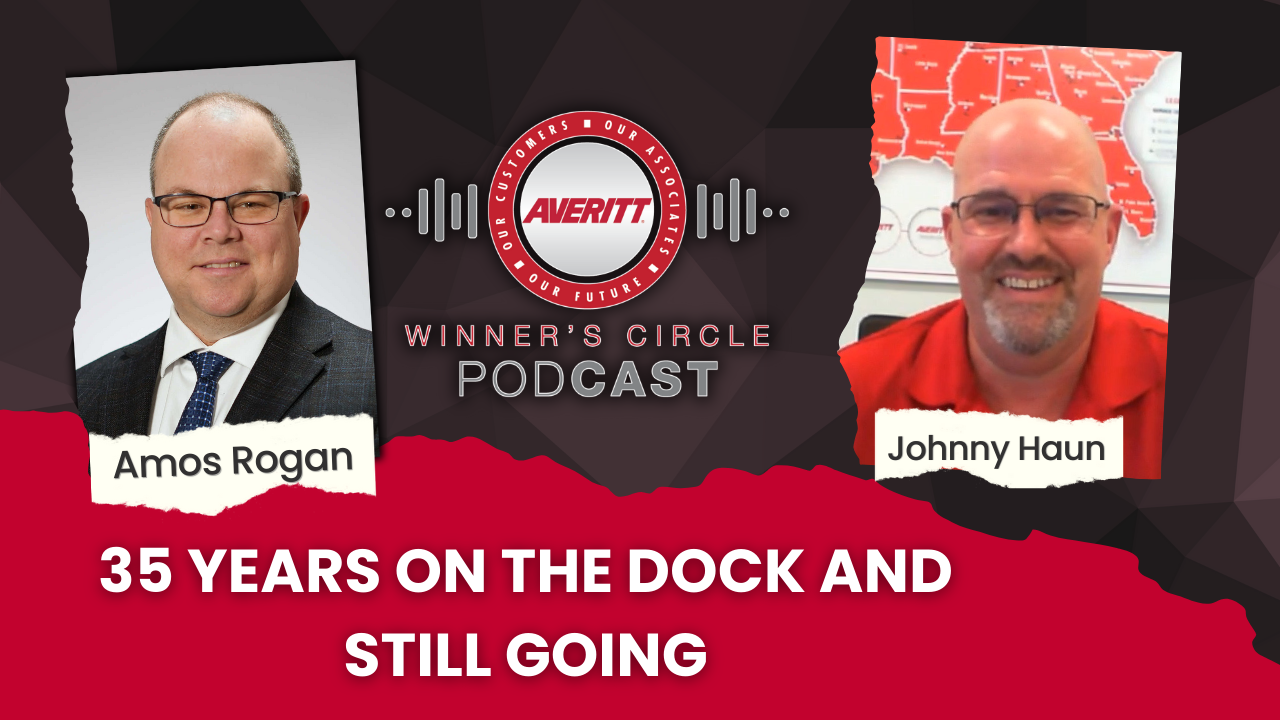







Over 20 Team: The Longevity of Our Associates
Long-term commitment, supported by experience and consistency, plays an important role in keeping our team strong. The Over 20 Team recognizes...


From great pay and benefits to our late-model equipment to our state-of-the-art facilities, you'll find the best benefits on the road here at Averitt.
The Averitt blog features tips, videos, podcasts, news, and experiences from real team members.
A library of documents and downloads that can help you as you research your future career.
Click below to read real reviews from Averitt drivers and associates.
Want to learn more about an exciting career with us? Stop by an upcoming career fair or hiring event throughout our network!
Our staff of recruiters is available to call or text. Reach out now!
Answer a few quick questions to determine your best fit at Averitt.
Get the answers to our most frequent questions – or ask your own!
![]()
With so many options, a career in transportation is a smart step for you no matter what stage you are in. At Averitt, we have multiple opportunities to help you fine-tune your skills!
![]() |
![]() |
![]() |
Dock-to-Driver Program |
Leadership Development |
Part-Time Internships |
|
Get paid to work on the dock while learning the skills to earn your CDL. |
3- to 6-month training program designed to prepare trainees for an entry-level leadership opportunity with Averitt. |
Learn about the diverse services we provide while exploring various aspects of the supply chain management cycle. |
17 min read
Averitt Careers
:
4/9/24 12:00 AM
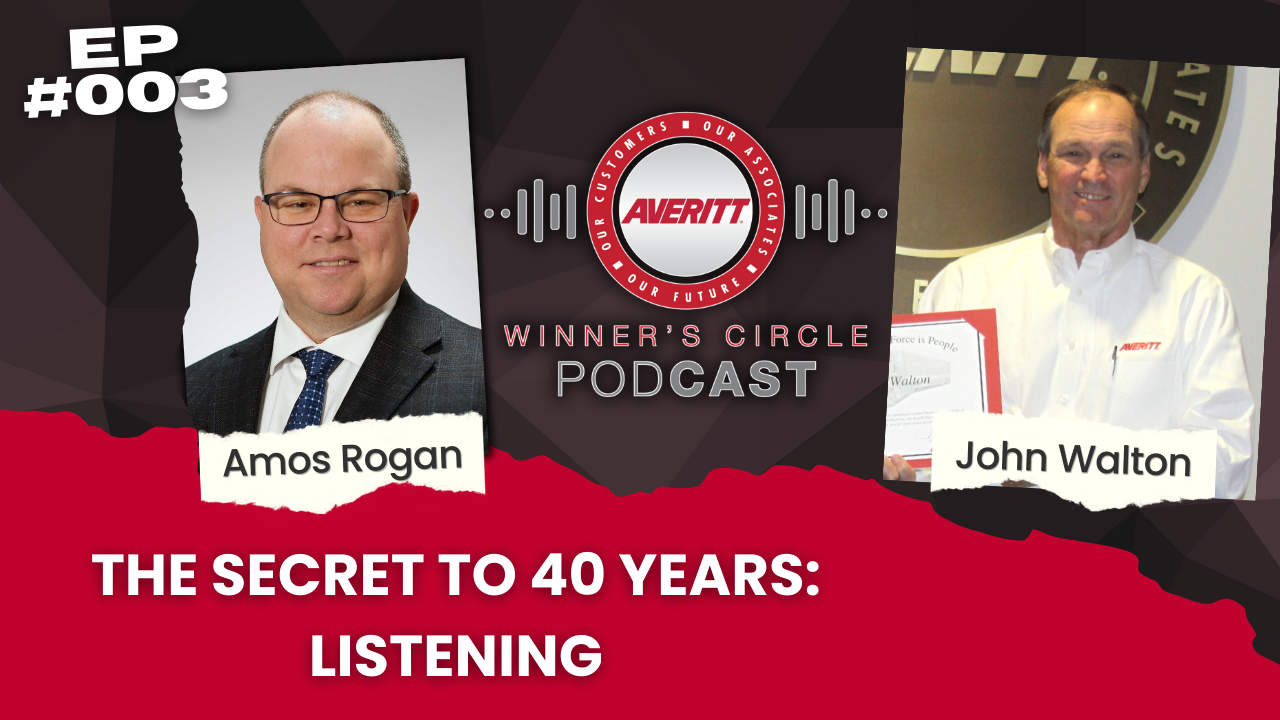
John Walton's Averitt career spanned four decades, starting in Memphis and wrapping up at our corporate office. From part-time driver to director of safety and compliance, John saw a lot of change over the years. But what remained the same was what he saw as the secret to success: listening. Host Amos Rogan sits down with John to talk about his long career with the Averitt team.
Are you looking for a career at a company with opportunities to learn and grow? The Averitt team may be a fit for you!
Welcome to the winner's circle, a podcast about the Avid culture and what makes our team unique. Don't forget to subscribe on your podcast app of choice. And now your host of the winner's circle, Amos Rogan. Hey. Welcome everybody to the winner's circle. We got a very special guest today, one that that I think, if you've been around anytime at all, you will know his name. He he has been so integral in what we do from a safety standpoint, and just been able to to guide us and lead us through so many different things as our industry has changed. So, please welcome mister John Walton. John, thanks so much for for coming on. Well, thank you, Amos. Appreciate the opportunity to, be here today and and, chat with you. Yeah. And, thank you for the kind words. But, I'm looking forward to talking today and and and, speaking about Averitt and about maybe what I've done and and, share some some lifetimes Yeah. My favorite. Yeah. You know, it seems like forty years is a lifetime. So It can be. It can be. Yes. You know, John is is just recently retired from the team. And and, after a very, long and, illustrious career and respectable career at that. But I wanna kinda start back at beginning. I know you're, originating in Memphis. That's that's where you started with us, and that's kinda where you're from as well. But kinda start us out there to where we can kinda get to today. Okay. Of course, I was, a military baby, if you will, and, was born in Millington Naval Air Base. And then my dad was transferred to Cecil Field in Jacksonville for a little while, then he was able to come back and retire in Memphis. And that was in fifty six. And so I lived in Memphis from fifty six till I came to corporate in nineteen ninety one. When I started with Averitt Express, I was going to Memphis State, which which is now University of Memphis. I was a late person to go to college. I was thirty one years old. Mhmm. So, I had driven a couple years prior, for another carrier, my father-in-law. And, I decided I wanna do something other than, run over the road. And, of course, my wife had been on me about why don't you go to school? You were gonna go to school out of high school, but you didn't. And so I took her advice and and, started, going to school. And then I started working part time, driving for other carriers. And I was, able to come on board at Averitt as a part time driver. And, so I drove part time and did other duties, doc, picked up late freight because I come in after school. Mhmm. Deliver late freight, pick up late freight, and then, unload my trailer if the if the trailers were still there, outs the outbound trailers, load those, if not, trap my freight. So that was that was basically what I did for three years. And how did you learn of Averitt in Memphis? I worked part time at another carrier, and the the service center director at that carrier, it went out of business. And he came to Averitt as the service center director. So I knew him, driving part time at a previous carrier. Mhmm. And, he and I happened to meet, out somewhere. I can't remember where. And talked about, how's it going? Are you getting enough hours? Because I needed the hours being a a full time college student. Sure. And, he said, well, I'm now with a company called Averitt Express. We're the kind of the new kids on the block in Memphis. Why don't you come see me and let's talk? Yeah. So I came that Monday after class and, sat down with him. And, we talked about it, and he said, hey, I'll work around your school schedule. We've got plenty plenty of freight, plenty of work right now, and I'd love to have you on board. And I said, well, it sounds like a great deal because now I know I don't have to live by the telephone when I get home. We didn't have cell phones back then. So you had to live by the landline and that is not fun. Yeah. It's, you know, waiting for the phone to ring or you call and do we have anything? And they go, no, not yet. I'll call you. Yeah. And that's that's kinda, you know, when you go to school as a late as a adult, you have a family and and and you need that income. So Sure. It was a blessing, to run into that guy and, have the opportunity, to have some stable, everyday work, and I enjoyed that. But that was, that was kind of my walk to get to Averitt when when I came in nineteen eighty four. As a matter of fact, March of eighty four. So this month is forty years total, for for me. So what was the first truck you ever drove at Averitt? What kind was it? Well, we had we had some Averitt, vehicles in our fleet, but we had a lot of rental, trucks too. Mhmm. And, it was a cab over Freightliner, and, it was rough. You couldn't let out One or two gear shifts. One or two gear shifts. High and a low? The the the one that I drove, I think I think yeah. It was you you it had a splitter. Yeah. So it was you know coordinated dance inside the cab just to drive the thing down the road. If you if you let out on the clutch easy, it would buck. And you'd think the dash was gonna come off. So you either had to let the clutch out Yeah. Or you had to push the clutch in. Yeah. One or the other. Yeah. So, obviously, you you were a city driver and and and worked your way through school, driving for us in Memphis. And then as you said, in nineteen ninety one, you made the move to corporate, and that was primarily in our safety department. Right? So what intrigued you about getting involved on the safety side of things? That's that's a very good question. I didn't really intend when I started with Averitt, to be at Averitt. But as I started working and doing the things that I was doing and and I could tell, I could tell that that that Averitt was a different place because I had I had been at four other carriers before I came to Averitt. And and by having that exposure, which I think was excellent, it allowed me to understand and appreciate where I am now. I mean, my dispatcher, I'd give him, for example, my school schedule, and we'd work around it. And I mean, how great is that? Yeah. And some days, you know, if if you've been to college, you have lab days. Sure. And that just messes up a day. Yeah. Really does. It's a two o'clock class or something. And and but but Avery always worked around it. So as I did that, when I went, full time, I stayed in the driving ranks and had the opportunity to train. Mhmm. I thought that was a great way to give back. So I was a driver trainer. And I was actually doing that in road test before I was full time because come in in the afternoon, hey, can you take this gentleman out on a road test? Here's the form. Here's how you do it. Taught me how to use it. So I was doing that already and then, you know, maybe deliver freight too because that way they wouldn't tie up a full time driver, who was, you know, trying to deliver freight as well. Sure. So I got to meet John Grant. At that time, he was a he was a safety director. And we just got to chatting because we were talking about road testing, and I was asking him questions about the road test. And am I doing it correctly? Is this what you want? And and that type thing. And, we hit it off. And, the next thing you know, I get a call or, call me in the office and they say, hey, John's on the line and and wanna talk to you. I said, okay. He said, how about doing some regional, safety training, in west western part of the state? You know, we had a lot of service centers in Tennessee at the time. Yeah. We did. You know, the Martins, the the the Dyersburgs, and and a lot of them, Mayfield. And, so they sent me the material, and I read it and looked through it and and then called John back and made sure I understood the material. And so on a Saturday, I would go teach class somewhere. That kinda I'm glad you said that because that kinda leads me into my next question for you is is, you know, you got into safety. You're at court at the corporate office now. You started out, you know, as you said, in a driver, but in a driver training type of of role, eventually, through your walk. How did once you got to corporate, how did using that experience of being a driver, being a driver trainer, how did that help you in being able to understand where we needed to provide more support and coaching opportunities for our drivers moving forward. When I first came to corporate, my my title was safety development leader. Mhmm. And my leader at the time was Scott Wolf. And he sat me down and said, hey. Here's some things that I need you to do right now. We need, we need a hazmat training program for our drivers and staff, doc. We need a right to know training program, and we need a forklift training program. We kind of don't have those right now. We're not sure where they are. And it was more hands on at the time. And so I I, I focused on that, first. But secondly, then we started working through, the safety documents, the the dry the road test, all the things that are needed for for a qualification file, a DOT qualification file. Sure. And the neat thing about doing those type of things and being in compliance with FMCSA is if you do everything that that's in the regulations and you teach and train that to your drivers, you'll have a safe driver. It's very interesting if you embrace it, and do what's in there. Mhmm. Yes. It's a compliance thing. If you're if you're gonna be inspected, yes. It's a client's thing. But it's also, a safety thing because if you're doing your hours of service, following those rules, you're rested. That's the purpose of the hours of service rules, being well rested and and ready for your day. Well, and I know I've sat through many meetings with you, on a variety of different subjects that that we've encountered over the years. And you've always been, in my opinion, the authority on what the rules and regulations say. I mean, if something comes up, you know, John would easily say, well, you know, per the FMCSA, blah blah blah blah blah. And I'm going, how do you know this? But, you've created such a name for yourself in the industry, but you've also been able to, put together a lot of peers throughout the industry from other carriers. But one of the things that I've always thought was just so smart for you to do and for you to lead and put our our company and our team in in a position to do was partner with law enforcement. And being able to get them in, get their opinions on certain situations, learn from them and some of the things that they have been faced, and also be open to allow them to utilize our facilities for their own personal training. Talk to us a little bit about where you felt like it was needed and necessary and where you felt like we could gain something from that partnership. That was a a unique thing. As as I did my walk, I was encouraged, which was great, to get engaged in the in the, transportation, seminars industry, American Trucking Association, Tennessee Trucking Association. I've also worked with a couple other state associations. Thus, you get that, you get that connection with your peers. Good good point on that because when you interact with your peers, you can talk openly because it's safety. It's all about safety. Right. It's not a marketing thing or something or you know sales environment. It's it's all about safety. Yeah. And you learn from everybody and thus doing that with our with the other peers, the other safety, folks in the industry, I got networked with some law enforcement through those guys. And when that happened, I thought, wow. When I get engaged with the Tennessee Highway Patrol, the Cookeville Police Department, the Putnam County Police Department, and then as well as other police departments throughout South Carolina, Traverse. And when you do that, there's a there's a stigma out there. It was at one time that that, oh my goodness. Don't let them in here. You know, they might audit you. Yeah. And, well, good. You know, if you're open about it and you've you got some gaps, you know, they're not gonna they're not gonna come down on you. They're gonna you work together. Does this look good? Is this what you're looking for on the roadside? Is this how you need a driver to interact with you at a roadside stop? Yeah. And we always got compliments, Amos. It was it was it was such a blessing. We get so many compliments when we do these co ops. We call them co ops with the law enforcement. They go, you know, those Averitt drivers, they're really different. You know, when we stop an Averitt driver, number one we know it's going to be a good stop. And number two they're going to follow directions. And that's the big thing that law enforcement will teach and train when you co op with co op with them, is that if they would just listen and follow my direction and just answer my questions, it's gonna be a good stop. Now you may have something that's out of compliance. Right. It can happen, but it'll be a learning tool, learning learning experience. And and they're people just like us. If if you get to know the law enforcement folks, they're just like us. Yeah. They have families. They have a job to do. And, it's I still, as a matter of fact, got a call yesterday from captain Douglas, THP just called me out of the blue and said, hey, I didn't heard from you. Why? How you doing? And, Retired. I said, well That's how I'm doing. I'm kinda I'm I'm kinda my my schedule's free and and, I'm under new management and check with my spouse. That's good. But just the just the fact that he called me out of the blue was was we're we had a good talk. Yeah. Well, you know, the the the safety team as a whole that we have here is a direct reflection of your long standing leadership and and, knowledgeable and supportive group to all of our associates in the field and as well as corporate as well. But, you know, we always talk about within Averitt, and our culture is we always enjoy promoting from within and and being able to put people in position to take the next step. How proud of you are of Jason Bolton in being your successor and moving the the ball forward for us? Jason, has been with me in the safety role for twenty years Yeah. Give or take, as a safety coordinator and corporate safety manager. And, Jay Jason brings a lot of tools and a lot of knowledge to our team. Much like me, Jason was a shuttle driver, frontline leader, sales, that I can think of right now off top of my head. So he has a lot of errors in his quiver that are not safety related yet. And and and that that's important the more you know, about everything that goes on in just our walk, Averitt walk, transportation walk, It makes you, it makes you more knowledgeable, makes you better. The the opportunities that you work through and those different jobs, just makes you stronger. Sure. And you understand, you kind of understand how this thing all works together. And, so Jason, he's he's technologically smarter than me. I struggle sometimes with my iPhone when I was on the way. I've seen him work on your iPhone before. So I wasn't gonna bring that up, but I'm you did. Well, it went from a flip phone finally to an iPhone. And and, you know, Jason, he's just good at all that. I mean, he he's he's he's just so knowledgeable. He's he's he's real slick with the computer, creating PowerPoints, just all of that. And, great communicator. Yes. He, he can he can communicate on on what level he needs to. Is it is it the driver? Is it the staff? Or is it the the leadership in the field? Right. The the secret to success, I think, in any any job title or any position at Averitt is being able to listen to the person that's talking to you, that's call that's calling you, and listen, and then work through the problem and be part of the solution. Yeah. And that when they whomever it may be, and Jason has that talent as well, that when you hang up the phone with them, that type thing. It was a good experience. It wasn't it wasn't one of, oh, no. I don't want to call safety. No. I want you to call safety. Yeah. And let's talk and hey, I may ask you about your kids. Yeah. You know? Hey. How's how's little Johnny doing it? You know, baseball. I know he's he's doing this or, you know, so you talk about the family. Yeah. And that means a lot to someone when you talk about the the work related part, but also spend a couple of minutes, you know, however you do it. Yeah. How's your family? You're you're teeing me up like crazy on my questions. So, I mean, this is making it really, really easy. And the question that I wanna get to now is is since you just went ahead and put that on the tee for me is is you've always been a great example of what the agriculture is, teamwork. And, you know, I've seen you interact with your staff and your team and and coming in of the morning and saying good morning to them and and all that sort of thing. You you've always treated them more like family rather than, you know, subordinates or or something like that. You you've been very open and and transparent in your career, and allowing, some folks to kinda see a peek into the John Walton outside of Averitt, you know, type of thing. But, what do you what do you feel like is your favorite aspect of the overall Averitt culture within your forty year career? I think it's just personal relationships with all the fellow associates that I've come in contact with. It's it's, it's amazing. You know, we we we always talk about when you when a service center director or leader calls, it's not to say, hey, John. You have a good day. There's something going on, you know, and it usually begins with, hey, John. I have a driver or I have, you know, and then you start the process, to to work through that in the same thing with with the staff, you know, when like you said, when I come in in the morning, you know, I'm I make sure that that I go and speak to everybody If I can that morning, if it didn't, things just didn't start popping right out of the gate. Right. But to speak to everyone, how you doing? Hey, how so and so? But also, I encouraged my staff, safety coordinators, I encouraged them to always be thinking how we can do it better. There's no bad idea. Right. There's just there's just good talk. There's good. Let's just have a conversation. What do you think? What what's on your mind and that we might need to do or can we do better? And that goes all the way down to an admin person. Yeah. You know, just because I said or I think this is how we need to to do our day. And and if there's a better way to do your job, I wanna know. And let's talk about it. And if it's better, let's do it. Yeah. Just empower all of your staff to be thinking, you know, you just don't wanna be in a in a a rut. I don't wanna call it a rut. But, you know, your your day, you know, your day can be tough. Sure. We're in transportation. It's always something. And transportation, think about this, is where we came from when I started and where we are today, it's evolving. And you need to have your staff engaged to be on the cutting edge or, I think I heard Gary say one time, we won't be on cutting edge. We don't wanna be on the bleeding edge. Right. And I think that's where that came from. And so as a result, we've got to be forward thinking. I think it's a good word. It's forward thinking on whatever your job title or whatever your accountability may be is to how can we do it better. And Right. Yeah. And and you've kind of alluded to that, but specifically, if somebody is watching this podcast or listening to it, and they're aspiring to grow, whether it's just in leadership and whatever the area they're interested in or in particularly safety. What would be your advice to them as far as the steps that they need to take to put themselves in a position to grow? Well, I think it's real simple. Whatever you're doing now, whatever that may be, be thinking about if you want is what can I take on extra? Or, if you see a need, well, you don't look around. You know, if you see a need, well, go ahead and try. You know? I I I saw something, last week, and I can't remember who it was, but said that that I get I do better work. I do I get I learn more when I make mistakes. And I I thought through that. I go, well, that's pretty smart because by doing it, not being afraid to do it, you make a mistake or you you do it, but you can reflect back and go, okay. I learned that don't do that. I learned that this was good and you grow. So so that's I think that's, that's what I would like for, the folks that are around me is to, go for it. If you're if you're a frontline leader or you're a doc associate, and I'm an example of that, part time driver, it doesn't really matter if you see a need. Hey, I can do that. Yeah. Let me try to do that. And that demonstrates to the folks around you that your direct leadership or whomever it may be that, hey, that that guy, Amos, you know, he'll do anything. Yeah. If there's a need, hey, I'll help you break that trailer. Get in there and get dirty. You know, we were frontline leaders in the field, you know, we wore shirts and ties. So you'd always have to stick your tie in your shirt and you'd go home and your wife would look and go, what did you do? Yeah. Well, I got busy in a trailer. Yeah. And and, so for the to to to answer the question is, always be thinking about what can I do extra or above and beyond and people will notice? And people will notice that he's willing to do anything. And and that puts you that puts you out in front, and that gets your name out there. And and it it just it's just another feather in your cap. So, obviously, with that great advice, you're gonna take that good advice and gonna be a part of our ambassador team. Right? Yes. I've already I've already signed up, and I was gonna I've heard about it. You know, it's been, the marketing team's done a really nice job of of of promoting that and that type of thing. So, yes. I've already signed up, and I was wanting to contribute to the Averitt Cares for Kids. That's that's part of the program. Mhmm. So I'm already engaged in that. And, so I look forward to whatever whatever I might be able to contribute on in that process moving forward because Averitt's my family. And, it's good to be engaged. Yeah. It is. And and we want to engage because you are a shining example of not only our culture, the the growth, over the years, those types of things that you've been able to achieve and just serve as an example for so many different people. Whether they're in safety or driving or anything like that or not, it's it's been a a a great career for people to strive for and emulate as far as that goes. I know that miss Barbara has gotten a lot of things lined up for you, and I know that there's some travel going on. But tell us what else that you're gonna be doing as you step into retirement. Well, I've got a lot of projects I'm working on, and, and she's adding to my list, which is fun. Because I like doing things with my hands and and and, you know, it's like just like anything else whether it's here at Averitt or or if I'm at home, you know, to do a project and finish it. And and an example, I hung an exterior door, and it was it was kinda mean because I have older home. But it's kinda nice four days later, which a real guy could probably done it in two, to look back and go, you know, that was that's pretty that's pretty good. Yeah. And, but I I would say my future is we have travels. We we like to travel, but I may have some opportunities, to consult. So I don't know what that looks like. I'm I'm more or less right now just trying to understand retirement. I'm a rookie at retirement. And, so it's like being in junior high and you're a ninth grader. I you know, we were seven through nine and then ten through twelve in high school. And so you're a ninth grader, you're in baseball, you're you're good, you're great. You go to the tenth grade, and you're a rook. You're a rookie, and you're just, you know, cannon fodder for everybody else. So that's kind of the way I am in retirement. I'm a rookie at retirement. And, so I'm excited and and trying to figure out, you know, where where is that gonna go. Right. Well, we're very excited for you, and we're appreciative of of you in every single way. You've been a a a good example. You've been a good friend to me, and I appreciate that very much. And, congratulations, my friend. Thank you very much. Folks, thanks so much for listening and for watching. We appreciate it. Share this with all of our associates and family and friends. Be blessed. Be safe, and we'll talk to you next time.
Learn more about Averitt's team and culture or check out openings in your area.
Long-term commitment, supported by experience and consistency, plays an important role in keeping our team strong. The Over 20 Team recognizes...
In this episode of the Averitt podcast, host David Broyles sits down with Dayna Pierce to spotlight Averitt’s new uniform program partnership with ...
Jesus Medina has been a valued member of the Averitt team for six years, starting his journey with us as a part-time dock associate. His career...
Winner's Circle host, Amos Rogan, welcomes guest Steve McDonald, Vice President of Averitt Integrated. Steve talks about the concept of integrated...
Watch as LTL Operations Leader and Host of the Winner's Circle Amos Rogan talks with President Barry Blakely about Averitt's culture, stability, and...
Host Amos Rogan is joined by Skylar Hamilton (frontline leader), Lacenia Calloway (transportation specialist), and Samar Gaorgy (administrative...